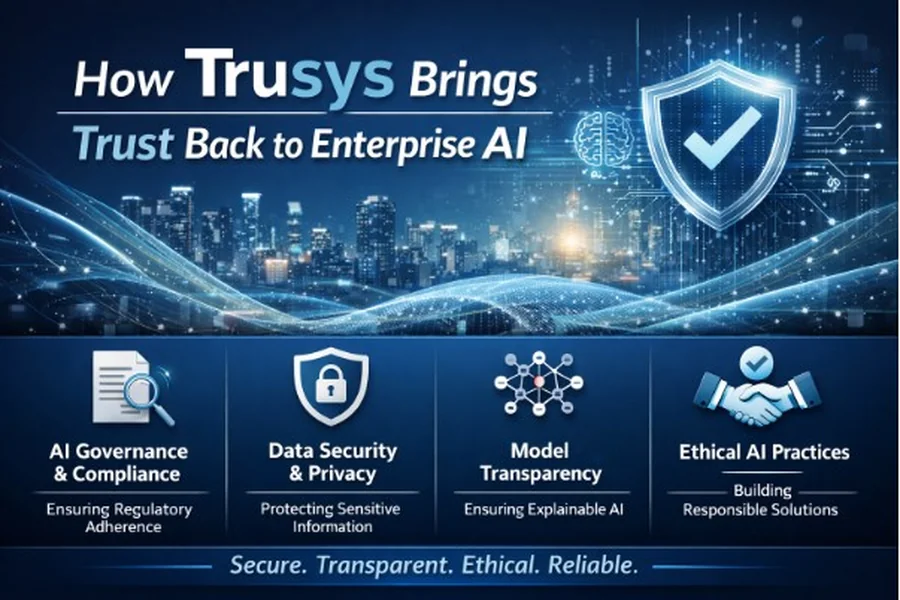
Artificial intelligence is everywhere, and frankly, there’s no turning back. According to McKinsey, over 55% of organizations now use AI in at least one business function, while Gartner predicts that by 2026, 80% of enterprises will have used generative AI APIs or models. Sounds impressive, right? Yet here’s the catch—nearly 85% of AI projects fail to deliver expected value, largely due to poor data quality, bias, lack of transparency, and governance gaps.
When AI gets it wrong, businesses pay the price. From biased hiring algorithms to flawed credit scoring systems, AI mistakes can erode trust overnight. That’s exactly where Trusys steps in, helping enterprises shift from risky AI experimentation to Responsible AI backed by a comprehensive AI Assurance Platform.
Let’s break it all down.
Contents
- 1 The Real Cost of AI Failures in Enterprises
- 2 Why Responsible AI Is No Longer Optional
- 3 Introducing Trusys: Building Confidence in Enterprise AI
- 4 How the Trusys AI Assurance Platform Works
- 5 Trusys and Responsible AI: A Perfect Match
- 6 Why Enterprises Trust Trusys Over Traditional Tools
- 7 The Business Impact of Trusted AI
- 8 The Future of Enterprise AI Depends on Trust
- 9 FAQs
The Real Cost of AI Failures in Enterprises
AI errors aren’t just technical hiccups; they’re business risks. IBM reports that the average cost of a data breach involving AI-driven systems exceeds $4.45 million, while PwC found that AI bias and model inaccuracies can reduce customer trust by up to 25%.
More importantly, AI failures often result in:
- Regulatory penalties and compliance violations
- Reputational damage and customer churn
- Legal exposure due to biased or opaque decisions
- Operational inefficiencies and wasted investments
In regulated industries like finance, healthcare, and insurance, even a single AI misstep can trigger audits, fines, or public backlash. Clearly, “move fast and break things” doesn’t work anymore.
Why Responsible AI Is No Longer Optional
Responsible AI has become one of the most searched AI governance keywords globally, and for good reason. Enterprises are under increasing pressure from regulators, customers, and stakeholders to ensure AI systems are:
- Fair and unbiased
- Transparent and explainable
- Secure and compliant
- Accountable and auditable
According to Deloitte, 74% of executives worry about ethical risks related to AI, yet only 35% have formal Responsible AI frameworks in place. That gap is dangerous. Without guardrails, AI models can drift, amplify bias, or make decisions no one can explain.
This is where Trusys changes the game.
Introducing Trusys: Building Confidence in Enterprise AI
Trusys isn’t just another AI tool—it’s a purpose-built AI Assurance Platform designed to bring trust, accountability, and transparency back into enterprise AI ecosystems.
Instead of reacting after failures occur, Trusys enables organizations to proactively monitor, validate, and govern AI models throughout their lifecycle. From development to deployment and beyond, Trusys ensures AI systems behave exactly as intended.
In short, Trusys helps enterprises move from blind trust to verified trust.
How the Trusys AI Assurance Platform Works
Trusys takes a holistic approach to AI assurance. Rather than focusing on a single risk area, it addresses the full spectrum of AI concerns.
1. Model Validation and Performance Monitoring
AI models don’t stay accurate forever. Data changes, user behavior evolves, and models drift. Trusys continuously monitors AI performance, ensuring accuracy, reliability, and consistency over time.
Stat to note: Research from MIT shows that model drift can reduce AI accuracy by up to 30% within the first year if left unchecked.
2. Bias Detection and Fairness Analysis
Bias is one of the biggest threats to enterprise AI. Trusys identifies hidden biases across datasets and models, helping organizations meet fairness standards and Responsible AI commitments.
This proactive bias detection reduces legal exposure while protecting brand reputation.
3. Explainability and Transparency
Black-box AI is a deal-breaker, especially in regulated sectors. Trusys provides clear, human-readable explanations for AI decisions, making it easier for stakeholders, auditors, and regulators to understand outcomes.
According to Gartner, explainable AI will be a top requirement for 75% of enterprise AI solutions by 2027.
4. Governance, Risk, and Compliance Alignment
Trusys aligns AI systems with global regulations such as the EU AI Act, GDPR, and industry-specific compliance standards. Built-in audit trails and documentation simplify reporting and regulatory reviews.
Trusys and Responsible AI: A Perfect Match
Responsible AI isn’t just a buzzword for Trusys—it’s the foundation. The platform embeds ethical principles directly into AI workflows, ensuring accountability at every stage.
With Trusys, enterprises can:
- Define ethical AI policies
- Enforce governance rules automatically
- Track accountability across teams
- Demonstrate compliance with confidence
This structured approach transforms Responsible AI from a theoretical concept into an operational reality.
Why Enterprises Trust Trusys Over Traditional Tools
Traditional AI monitoring tools focus on performance metrics alone. Trusys goes further by combining technical validation, ethical oversight, and regulatory compliance in one unified AI Assurance Platform.
Here’s why that matters:
- 63% of enterprises struggle to integrate AI governance tools, according to Accenture
- Fragmented solutions create blind spots
- Trusys delivers a single source of truth for AI trust
As a result, organizations gain faster approvals, safer deployments, and stronger stakeholder confidence.
The Business Impact of Trusted AI
When enterprises implement Trusys, the benefits go beyond risk reduction. Trusted AI drives measurable business value.
Companies using structured AI assurance frameworks report:
- 20–30% reduction in AI-related incidents
- Faster AI deployment cycles by up to 40%
- Improved customer trust and retention rates
In other words, trust isn’t just ethical—it’s profitable.
The Future of Enterprise AI Depends on Trust
AI adoption will only accelerate. IDC forecasts that global AI spending will surpass $300 billion by 2026, yet trust will remain the deciding factor between success and failure.
Enterprises that ignore Responsible AI and assurance risk falling behind. Those that embrace platforms like Trusys position themselves for sustainable, compliant, and trustworthy AI innovation.
When AI gets it wrong, the fallout is real. But with Trusys, enterprises don’t have to gamble. They can build AI systems that are transparent, fair, and reliable—right from the start.
FAQs
What is an AI Assurance Platform?
An AI Assurance Platform validates, monitors, and governs AI systems to ensure accuracy, fairness, transparency, and compliance across their lifecycle.
Why is Responsible AI important for enterprises?
Responsible AI reduces bias, ensures compliance, protects brand reputation, and builds long-term trust with customers and regulators.
How does Trusys help with AI compliance?
Trusys provides built-in governance, audit trails, and explainability features that align AI systems with global regulations and ethical standards.
Final Thoughts
Trust is the currency of enterprise AI, and once it’s lost, it’s hard to regain. Trusys bridges the gap between innovation and accountability, helping organizations deploy AI with confidence. In a world where AI gets it wrong too often, Trusys brings trust back—where it belongs.